

Think Big, Start Small: How to Build a Cost Engineering Organization from the Ground Up
This is Part 1 of a five-part series on building a should-cost engineering organization. The series draws on practical experience scaling cost engineering capabilities within a large global procurement organization and is written for professionals who are building, growing, or advocating for cost engineering within their own companies.
• • •
Every cost engineering organization starts somewhere. For some, it begins as a single analyst embedded in a procurement team, quietly building should-cost models that nobody asked for but everybody finds useful. For others, it is a deliberate investment by leadership, a bet that cost transparency will change how the company negotiates. Regardless of how it starts, the trajectory is remarkably similar: a small team proves its value in a narrow space, earns credibility through results, and gradually expands into something the broader organization cannot imagine operating without.
I have had the privilege of being part of that journey firsthand. The cost engineering function I work within started with just two people in 2022. Today, it has grown to more than thirty, supporting multiple procurement categories and operating across specialized pillars including market intelligence, value engineering, and digital cost analytics. The savings the team has enabled run well into the hundreds of millions of dollars.
That growth did not happen by accident, and it certainly did not happen overnight. It followed a set of principles that I believe apply to any organization attempting to build this capability. The single most important principle is deceptively simple: think big, but start small. Have a clear vision for what a comprehensive cost engineering function could become, but resist the urge to chase that vision all at once. Instead, prove your value in one category, with one product, for one stakeholder. Earn trust through results, not promises. Everything else follows from there.
Where Should Cost Engineering Sit?
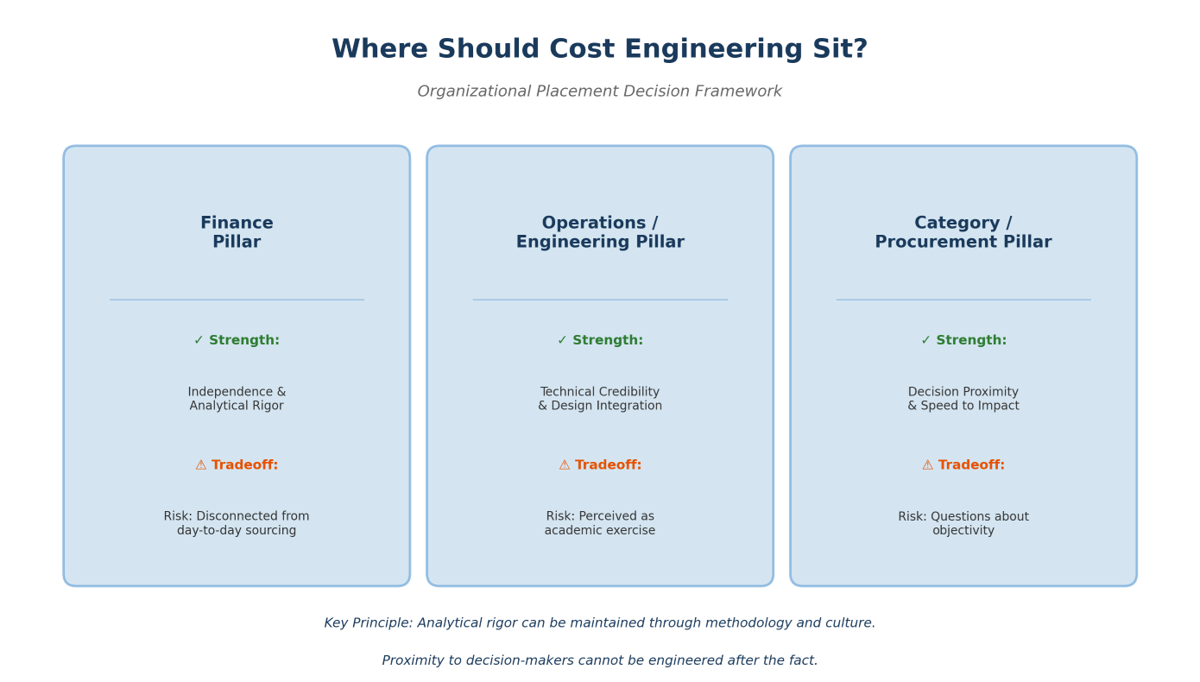
Before building anything, an organization must answer a deceptively important question: where should cost engineering sit? This decision shapes everything that follows — access to stakeholders, credibility, the ability to influence decisions, and even how the work is perceived.
There are three common options, and none is universally correct. Placing cost engineering within Finance gives the function independence and analytical credibility, but it can disconnect the team from the daily rhythm of sourcing activity. Analyses may be technically rigorous but arrive too late or too far removed from the negotiation table to matter. Embedding the function within Operations or Engineering provides deep technical credibility and natural alignment with design-to-cost initiatives, but it may lack integration with procurement processes. The engineers trust the work, but category managers may view it as an academic exercise.
The third path — and the one I have seen work best in a procurement-heavy context — is placing cost engineering within the Category or Procurement pillar, close to Sourcing Excellence. This placement puts cost engineers shoulder-to-shoulder with the category managers who actually negotiate supplier contracts. They attend pipeline reviews. They understand timelines, pain points, and relationship dynamics with suppliers. That proximity is invaluable — it means cost models arrive when they are needed, informed by the context of the negotiation, not produced in isolation and handed over as a finished product.
The tradeoff of sitting within procurement is that it can raise questions about objectivity. The key to managing this tension is maintaining analytical independence through rigorous methodology standards and a willingness to tell category managers things they may not want to hear. A cost model that always confirms the buyer's position is not a cost model — it is a negotiation prop. The moment analytical integrity is compromised, the function loses the very credibility that makes it valuable.
For anyone making this decision at their own organization, the advice is straightforward: consider where your cost engineering team will have the most direct access to the decision-makers who will act on the work. Your company's culture, strategic priorities, and existing capabilities should guide this choice. Analytical rigor can be maintained through methodology and culture. Proximity to decisions cannot be engineered after the fact.
Defining the Vision Before Building the Team
With the organizational home established, the next step is articulating what the function is building toward. Not what it will do in the first six months — that is tactical. The team needs a picture of the mature state, the organization it wants to become in three to five years. This matters because every early decision — which skills to hire for, which tools to invest in, which stakeholders to cultivate — will either move toward that vision or away from it.
A strong vision for a mature cost engineering function typically has several components. It includes comprehensive should-cost modeling across every major procurement category, so that category managers walk into supplier negotiations armed with detailed cost breakdowns and the technical arguments to back them up. It includes supporting pillars — market intelligence feeding real-time data into models, value engineering challenging whether the organization is buying the right thing in the first place, and digital analytics tools that allow the function to scale its impact far beyond what headcount alone could achieve.
That is the destination. But having a bold vision is dangerous if you try to build it all at once. I have seen organizations attempt to stand up a full-scale cost engineering function overnight — hiring a dozen people, licensing expensive software platforms, and promising leadership transformational savings within a quarter. It almost never works. You end up with a large team that has no track record, no credibility with stakeholders, and no demonstrated methodology. When the promised savings do not materialize on schedule, leadership loses confidence and the entire initiative is at risk. The antidote is discipline. Know where you are going, but earn the right to get there one step at a time.
One Category, One Product, One Win
The first practical step is choosing a single category to support. This decision deserves more thought than it might seem. The category should have spend significant enough that even a modest percentage improvement produces meaningful dollar savings. It should have enough complexity to showcase what cost engineering can actually do — if the product is a simple commodity with transparent market pricing, a should-cost model does not add much value. The stakeholders need to be receptive, or at least open-minded. And critically, there needs to be the possibility of a quick win — a result the team can point to within three to six months.
This selection matters because in the early days, the purpose of the work is not just to deliver savings. It is to earn the right to exist. Every interaction with a category manager, every cost model delivered, every negotiation supported is an audition. If the first category manager the team works with walks away thinking the analysis was useful and the team was easy to partner with, they will tell their peers. Word of mouth is the most powerful scaling mechanism an internal function has. Get that first engagement wrong, and the whisper network works against you just as effectively.
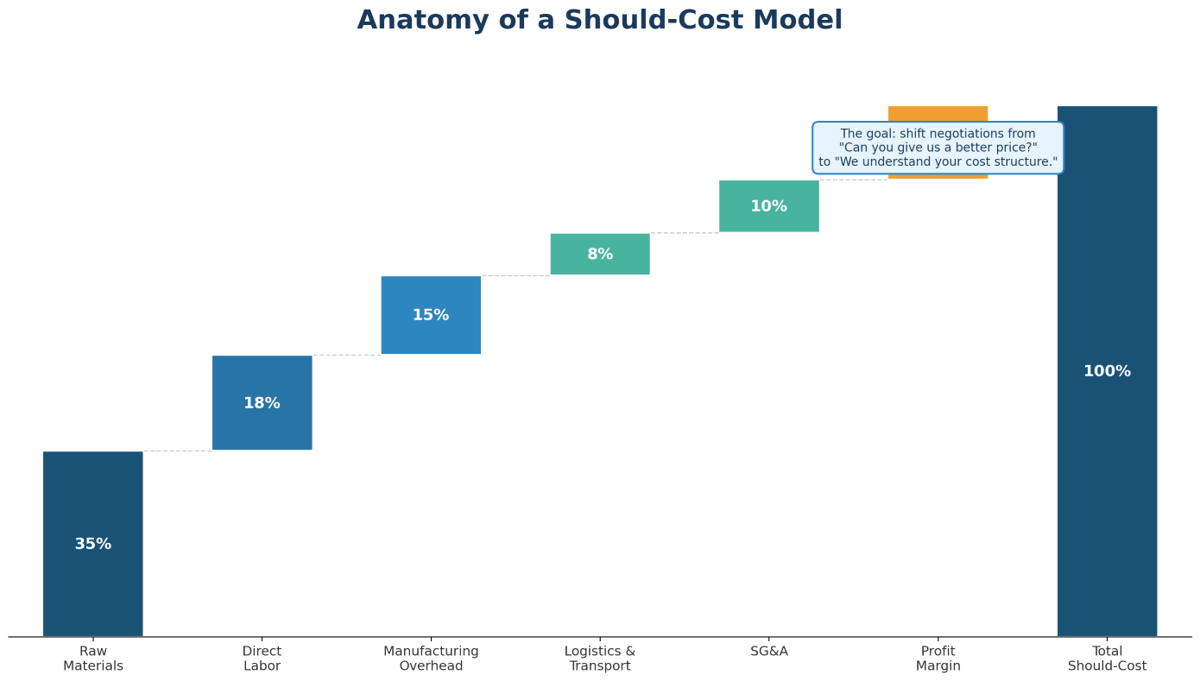
The first should-cost model should be built by working backward from how it will be used. A cost model sitting in a spreadsheet has zero value. A cost model that a category manager can bring into a negotiation — with clear cost breakdowns showing direct materials, direct labor, manufacturing overhead, logistics, and profit margin — changes the entire dynamic of that conversation. It shifts the discussion from "Can you give us a better price?" to "We understand your cost structure, and here is where we see opportunities." That is a fundamentally different negotiation.
The role of the cost engineer in this process is not to replace the category manager. It is to arm them. The cost engineer builds the ammunition; the category manager fires it. This distinction matters enormously for positioning the function with stakeholders. Category managers can feel threatened by cost engineering if they perceive it as an audit function or a second-guessing mechanism. But if the approach is partnership — "I am here to make your negotiations stronger" — the dynamic changes entirely.
The First Result That Changes Everything
The first engagement rarely goes smoothly. The initial model almost always takes longer than expected. Teams typically underestimate the effort required to gather accurate input data — supplier manufacturing processes, regional labor rates, raw material specifications, logistics assumptions. You learn quickly that the quality of a cost model is only as good as the data underneath it, and that much of the data needed does not exist in a single convenient location.
But when that first model is used in an actual negotiation, the results are usually unmistakable. The category manager walks into the room with a detailed cost breakdown that the supplier cannot dismiss. Instead of the usual back-and-forth on percentages, the conversation focuses on specific cost drivers — why labor content seems high relative to benchmarks, whether material yield assumptions are realistic, where logistics costs could be optimized. The supplier engages with the substance because they have to. The result is a negotiated outcome significantly better than what a traditional price-based approach would have achieved.
That single engagement generates more credibility than any presentation to leadership ever could. The category manager becomes an advocate. When peers ask how the negotiation went so well, the answer is: "The cost engineering team built me a model that changed the conversation." That is the moment when a cost engineering organization stops being an experiment and starts being a capability that people want access to.
Tracking and communicating that result rigorously — the savings identified, the savings achieved, the gap to should-cost, the improvement in supplier transparency — is essential. Not because the team needs to justify itself in that moment, but because it is building the evidence base for everything that comes next. When the time comes to request additional headcount, additional tool investment, and additional category coverage, the conversation should be grounded in demonstrated results, not projections and assumptions.
• • •
In Part 2 of this series, "Earning Trust One Model at a Time", I will discuss how to scale from that first win into multiple categories — the governance frameworks to establish, the stakeholder relationships to cultivate, and the business case that convinces leadership to invest in growing the team.
 |
Nikhil Gaur is the Global Sourcing Excellence Lead for Packaging and Tech Categories at Amazon's Global Procurement Organization (GPO), where he leads cost and value engineering efforts across both categories. Copyright © 2026 – Society of Product Cost Engineering & Analytics. All rights reserved. |